If you're buying or placing a manufactured home in North Carolina, understanding wind zones isn't optional. It's a legal requirement that directly affects your home's safety, compliance, and insurance costs. North Carolina wind zones determine how your home is built and anchored, and getting it wrong can lead to permit denials, voided warranties, and serious safety risks during storms.
What Are Wind Zones?
Wind zones are geographic classifications established by HUD (the Department of Housing and Urban Development) in 1976 as part of the Manufactured Home Construction and Safety Standards. These zones divide the United States into three categories based on the maximum wind speeds each region experiences. Every manufactured home must be built to meet the specific wind zone requirements for its installation location.
The system is straightforward. Wind Zone 1 covers areas with wind speeds up to 70 mph, primarily inland regions where hurricanes are uncommon. Wind Zone 2 is designed for 100 mph winds in areas with moderate hurricane risk. Wind Zone 3 handles the most extreme conditions, with homes built to withstand 110 mph winds in high-risk coastal areas.
North Carolina's Three Wind Zones
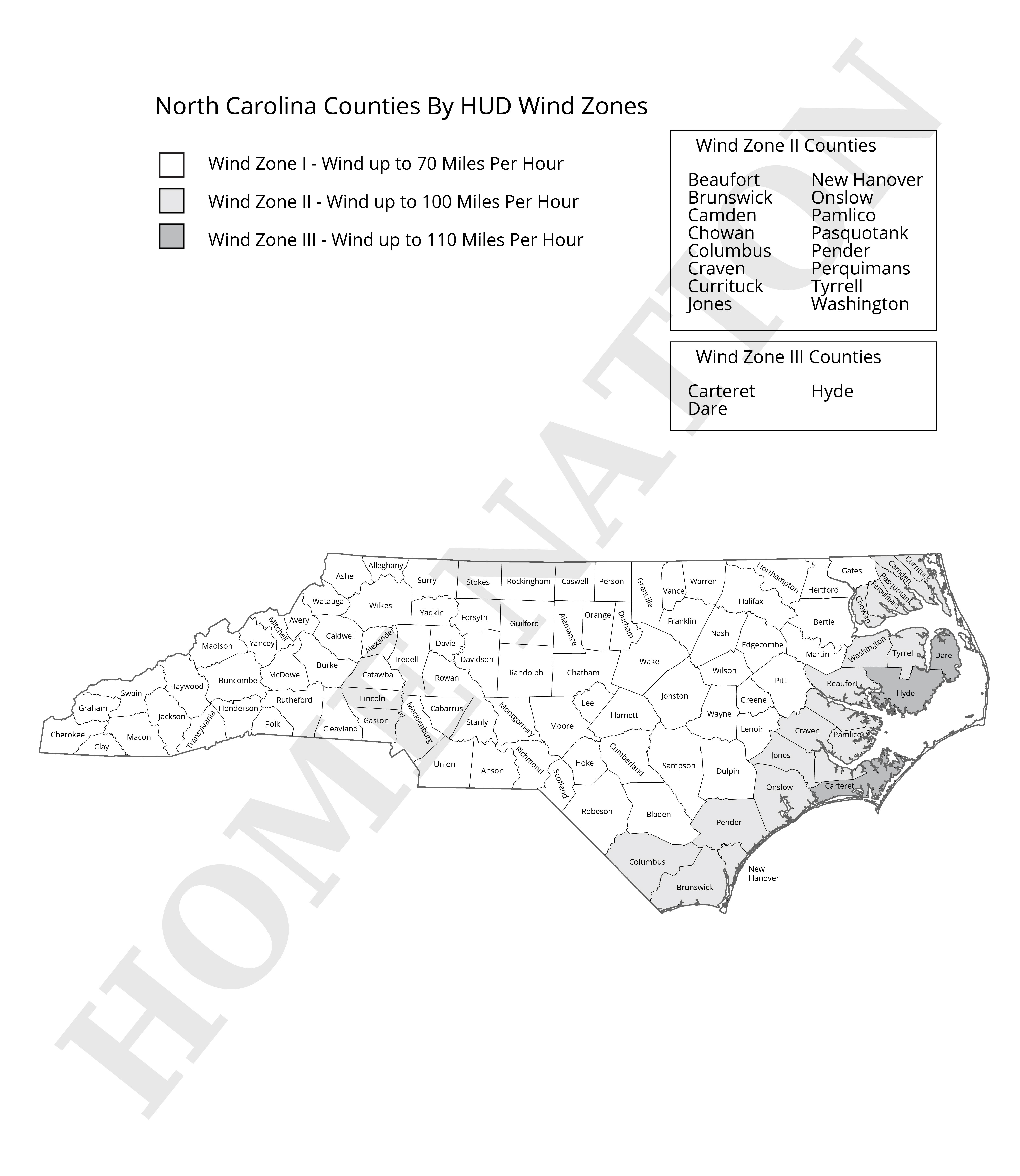
North Carolina is unique because it contains all three wind zones. The state's geography, stretching from the Appalachian Mountains to the Atlantic Ocean, creates dramatically different wind risk levels depending on location.
Wind Zone 1 includes much of central and western North Carolina. Areas such as Greensboro, Raleigh, and Charlotte fall within this lower-risk category since they’re far from the shoreline. Across the U.S., this mobile home wind zone remains the most frequently designated classification.
Wind zone 1 counties:
Alamance Alexander Alleghany Anson Ashe Avery Beaufort (inland portions) Bertie (inland) Bladen (inland) Brunswick (inland) Buncombe Burke Cabarrus Caldwell Camden (inland) Carteret (inland) Caswell Catawba Chatham Cherokee Chowan (inland) Clay Cleveland Columbus (inland) Craven (inland) Cumberland Currituck (inland) Dare (inland portions) Davidson Davie Duplin (inland) Durham Edgecombe (inland) Forsyth Franklin Gaston Gates (inland) Graham Granville Greene (inland) Guilford Halifax (inland) Harnett Haywood Henderson Hertford (inland) Hoke Hyde (inland portions) Iredell Jackson Johnston Jones (inland) Lee Lenoir (inland) Lincoln McDowell Macon Madison Martin (inland) Mecklenburg Mitchell Montgomery Moore Nash (inland) New Hanover (inland) Northampton (inland) Onslow (inland) Orange Pamlico (inland) Pasquotank (inland) Pender (inland) Perquimans (inland) Person Pitt (inland) Polk Randolph Richmond Robeson Rockingham Rowan Rutherford Sampson (inland) Scotland Stanly Stokes Surry Swain Transylvania Tyrrell (inland) Union Vance Wake Warren Washington (inland) Watauga Wayne (inland) Wilkes Wilson (inland) Yadkin Yancey
Wind Zone 2 applies to parts of the eastern and southeastern coastline, covering counties like Craven, Pender, Brunswick, Beaufort, Washington, Onslow, Columbus, Pamlico, Perquimans, Pasquotank, Jones, Tyrrell, Currituck, Camden, New Hanover, and Chowan. These communities face a moderate risk from tropical systems, so homes here must follow stronger construction standards than inland areas.
Wind zone 2 counties:
Wind Zone 3 pertains to the state’s highest-risk coastal zone, particularly the Outer Banks counties—Hyde, Carteret, and Dare. Because these locations endure the most severe hurricane exposure, they’re required to meet the strictest building codes for wind safety.
Wind zone 3 counties:
Related: What Is Windzone 3 - States Included and More

Why North Carolina Wind Zones Matter
The state's position on the Atlantic coast makes it vulnerable to hurricanes and tropical storms. North Carolina experiences an average of one to two hurricane impacts per year during storm season. These storms bring destructive winds, storm surge, and flooding that can devastate improperly rated homes.
When you understand North Carolina wind zones, you're protecting your investment and your family. Mobile homes built to the correct wind zone rating include reinforced framing, upgraded tie-down systems, and stronger roof assemblies. These aren't minor differences. A Wind Zone 1 home placed in a Zone 3 location simply isn't engineered to survive hurricane-force winds.
Related: What Is Windzone 2 - States Included and More
How Wind Zones Affect Your Home Purchase
You can't place a home built for a lower wind zone in a higher wind zone area. This is federal law, not a suggestion. A Zone 1 home cannot be installed in Zone 2 or Zone 3 counties. However, you can install a higher-rated home in a lower zone, which some buyers choose if they plan to relocate later.
The wind zone rating affects your home's structural design, anchoring requirements, and overall cost. Zone 3 homes cost more because they require additional engineering, stronger materials, and more robust anchoring systems. Insurance companies also factor wind zones into their rates. Homes in higher zones typically face higher premiums because of increased risk.
Your county permitting office enforces these requirements. Before purchasing a manufactured home in North Carolina, verify your property's exact wind zone classification. Don't assume, even if you think you know your area's designation. Coastal counties often have specific requirements, and properties within 1,500 feet of the coastline in Zones 2 and 3 may need additional engineering certification.
Finding Your Home's Wind Zone Rating
Manufactured homes produced after July 1994 include a HUD data plate identifying their designated wind zone. You can usually find this label near the electrical box, inside a cabinet, or in a bedroom closet. It lists compliance information, the manufacturer’s name, and maps showing the zones for which the home was approved.
If you can't locate the data plate, contact the Institute for Building Technology and Safety (IBTS) to request a replacement. Never assume a home's rating without verification. For those considering site-built homes for North Carolina, wind zone requirements still apply but follow different construction standards.
North Carolina Wind Zone Mobile Homes
Home Nation provides factory-direct manufactured homes built to meet all North Carolina wind zone requirements. Whether you need a Zone 1 home for inland counties or a Zone 3 home for coastal areas, our homes are engineered for compliance and safety. We understand North Carolina's unique requirements and can help you select the right home for your specific location.
Our team helps buyers understand building resilience and proper wind zone compliance without dealer markups. Ready to find your compliant manufactured home? Get preapproved today or explore our home trade-in options to make your purchase easier.