
Buying or building in the wrong snow load zone can turn a straightforward project into a permit headache. Different regions see very different snow loads each winter, and a snow load roof that isn't rated for local snow load requirements can fail inspection, void a warranty, or worse, buckle under a heavy storm.
Identifying your snow load rating before committing to a manufactured, site-built, or modular home project prevents costly delays. Early awareness enables productive discussions with contractors and ensures the home ordered matches its destination's specific requirements.
Key Takeaways
-
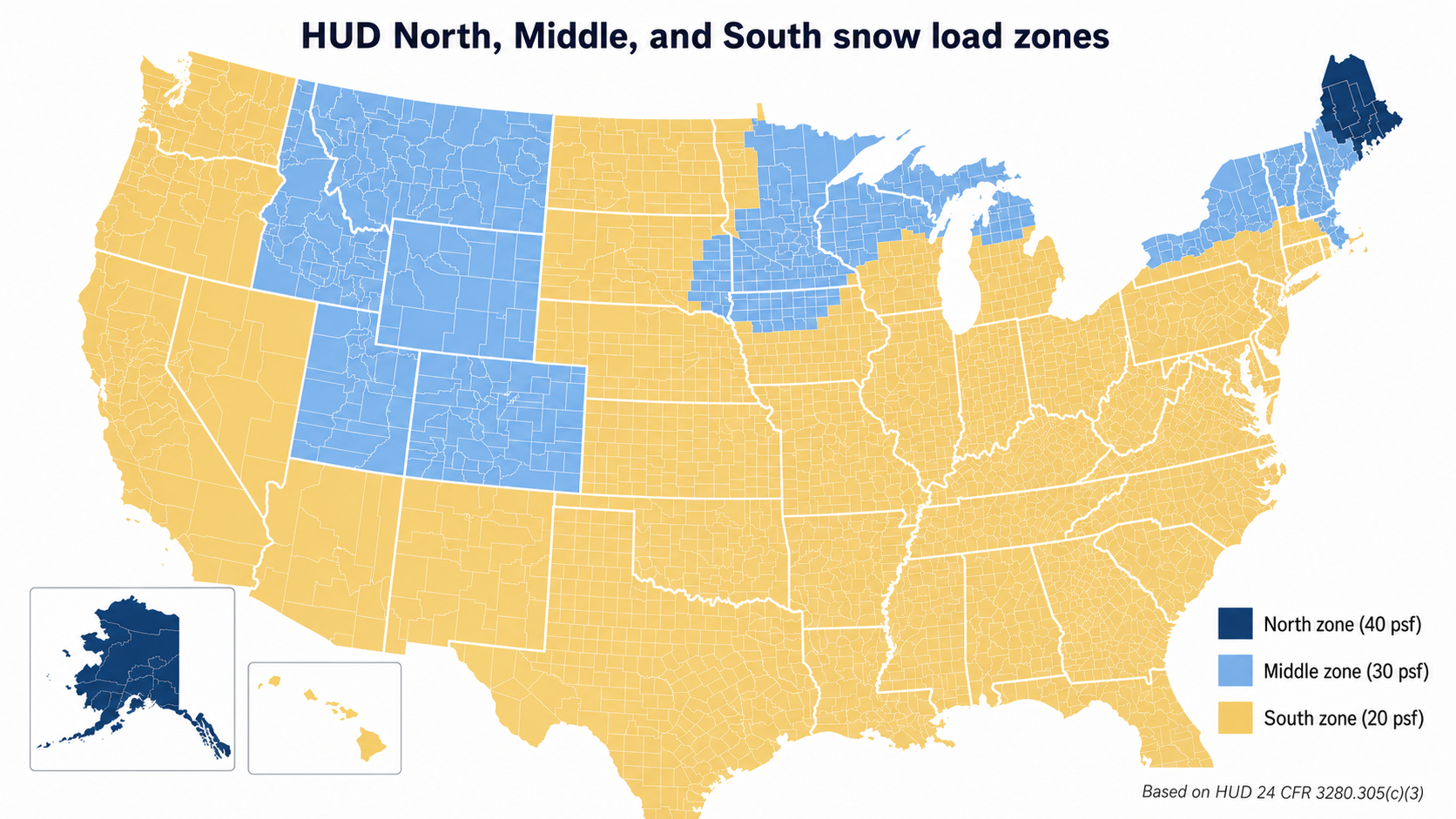
The U.S. is split into three HUD snow load zones, North, Middle, and South, each with a different required roof load.
-
North Zone homes must handle 40 pounds per square foot, Middle Zone homes need 30 psf, and South Zone homes need 20 psf.
-
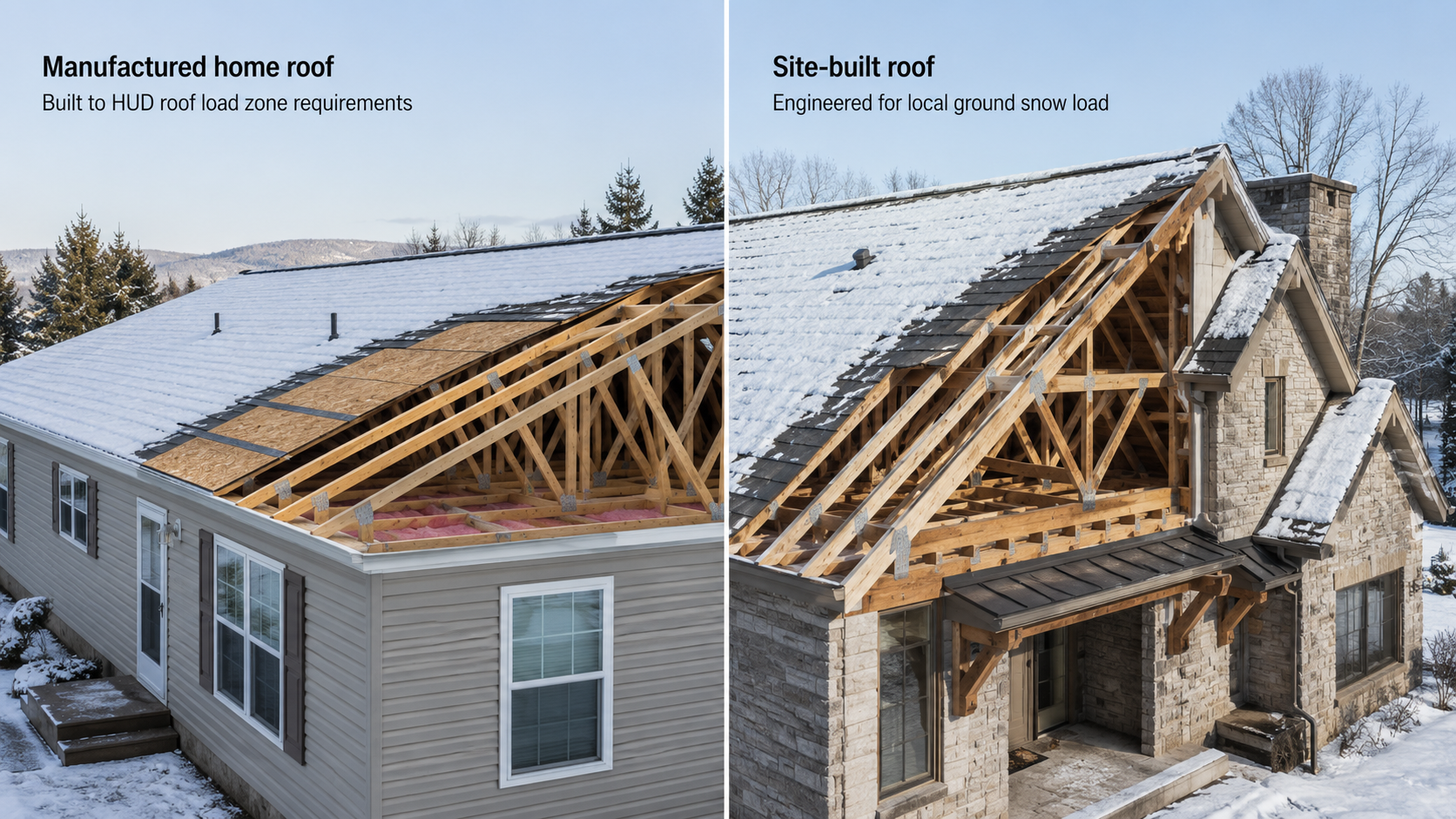
These HUD zones apply specifically to manufactured homes, not site-built or modular construction.
-
Site-built and modular buyers need a local ground snow load number from their building department instead.
-
Home Nation builds every manufactured home to match the roof load requirements of its destination zone.
What Is a Snow Load Zone?
So what is snow load, exactly? It's the weight of accumulated snow a roof has to support without failing, measured in pounds per square foot. You'll sometimes see it written as one word, snowload, but it means the same thing. HUD created three snow load zones, North, Middle, and South, to standardize how much weight a manufactured home's roof needs to carry depending on where it's headed.
Each zone comes with its own minimum roof snow load requirements, and HUD assigns every address a snow load rating based on where it falls on the map. You can confirm which zone a specific location sits in using the official roof load map maintained for manufactured housing, and the same snow load zones also line up with the mobile home wind zone maps that cover wind resistance. If you're building site-built or modular instead, your local building code sets a separate ground snow load figure, which we'll get into further down.
North Snow Load Zone – States Included and More
The North Zone carries the highest requirement at 40 psf. It covers all of Alaska, along with the northernmost counties in Maine, including Aroostook, Piscataquis, Somerset, Penobscot, Waldo, Knox, Hancock, and Washington.
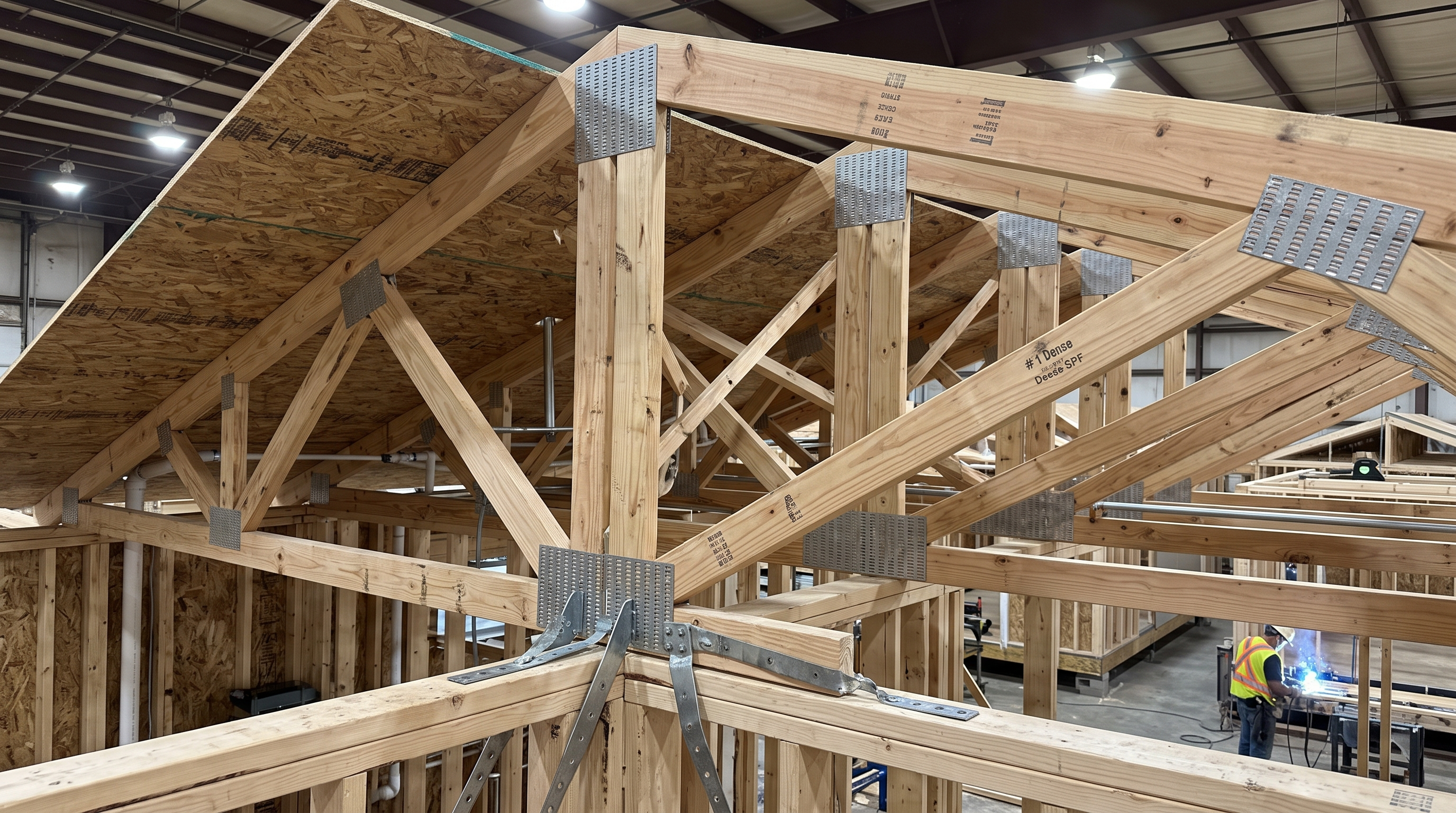
Homes built for this zone need reinforced trusses, sturdier rafters, and stronger connections between the roof and walls to handle sustained roof load capacity demands. If you're shopping specifically for cold climate homes, this is the zone where construction quality matters most, since a roof that's underbuilt here won't just fail an inspection, it can actually cave in under the wrong storm.
A common mistake is assuming any manufactured home works once it's moved north. A home rated for the South Zone and shipped to Alaska is a warranty claim waiting to happen.
Related: Best Prefab Homes for Cold Climates
Middle Snow Load Zone – States Included and More
Middle Zone homes need to handle 30 psf, and this is where most of the northern half of the country falls. Montana, Idaho, Colorado, Wyoming, Utah, and New Hampshire are Middle Zone in their entirety. Large parts of Minnesota, Wisconsin, Michigan, Iowa, South Dakota, New York, and Vermont are also Middle Zone, though coverage varies county by county rather than across the whole state.
Maine actually splits across two zones. Its far northern counties sit in the North Zone, while southern counties like York, Cumberland, and Androscoggin fall under the Middle Zone instead. Essex County in Massachusetts is the state's only Middle Zone county, with the rest of the state falling to South.
South Snow Load Zone – States Included and More
The South Zone is the default. Any state or county not specifically named in the North or Middle Zone lists automatically falls here, with a 20 psf roof snow load requirement. That covers most of the country, including places you might not expect given how much falling snow they can see in a rough winter, like parts of the Mid-Atlantic and interior Northeast.
Take a search like roof snow load for north east pa as an example. Pennsylvania doesn't appear anywhere in HUD's North or Middle Zone county tables, so the entire state, northeast included, falls under the South Zone at 20 psf. It's a good reminder that a region getting heavy snow falling most winters doesn't automatically put it in a higher zone. HUD's map is based on historical load data, not just how often it snows. For an authoritative look, you can review the roof load zones directly on HUD's site.
Related: Mobile Home Glossary
Manufactured Home vs. Site-Built: Does Your Zone Change?
HUD's three-zone map only applies to manufactured homes. For site-built or modular projects, local building departments determine the required ground snow load, which can vary by elevation or terrain. Accurate numbers are critical for mobile home installation, as they dictate specific roof requirements before setup begins.
Picture a park owner setting a manufactured home in a mountain valley in Colorado. The HUD map places the whole state in the Middle Zone at 30 psf, but the county building department might require a higher ground snow load for that specific elevation. In a case like that, local code wins, and the home still needs to clear that inspection even though it already meets its HUD zone on paper.
Snow Load Calculator – Find Your Zone
There's no plug-and-play snow load calculator built into this guide yet, but finding your zone is still straightforward. If you've ever wondered what is the snow load for a roof in your specific county, start with the tables above. If your county is named in the North or Middle Zone lists, that's your answer. If it isn't listed anywhere, you're in the South Zone by default.
For site-built or modular projects, skip the HUD map entirely and call your local building department directly, since they'll give you the exact ground snow load figure your permit depends on. And if you're comparing options across zones, exploring the double-wide homes for sale that Home Nation ships factory-direct is a good next step, since every model is built to match its destination zone's roof load requirements from the start.
Financing shapes a lot of these decisions too, and checking financing options for all credit types is a practical way to start pricing out a home that's already built for your climate.
Getting your snow load zone right before you buy or build isn't just paperwork. It's the difference between a roof that holds up for decades and one that needs repairs after its first hard winter. A snow load roof built to the wrong number is one of the most avoidable mistakes in this process, and Home Nation builds every home, single-wide, double-wide, or custom floorplan, to match its destination zone from the start.