Understanding Texas wind zones matters more than you might think. If you're planning to buy a manufactured home in Texas, you need to know which wind zone applies to your area. Get it wrong and you could face permit denials, voided warranties, and serious safety risks during severe weather.
Wind zones were established in 1976 as part of the HUD Manufactured Home Construction and Safety Standards. These zones ensure every manufactured home can withstand the specific wind conditions where it's installed.
What Are Texas Wind Zones?
Texas has two designated wind zones:
Wind Zone 1: Covers most of the state. Homes must withstand wind speeds up to 70 mph. This includes all interior counties from the Panhandle down through Central Texas and out to West Texas. Cities like Dallas, Austin, San Antonio, El Paso, and Amarillo fall into this category.
Wind zone 1 counties:
Anderson Andrews Angelina Archer Armstrong Atascosa Austin Bailey Bandera Bastrop Baylor Bee Bell Bexar Blanco Borden Bosque Bowie Brazos Brewster Briscoe Brooks Brown Burleson Burnet Caldwell Callahan Camp Carson Cass Castro Cherokee Childress Clay Cochran Coke Coleman Collin Collingsworth Colorado Comal Comanche Concho Cooke Coryell Cottle Crane Crockett Crosby Culberson Dallam Dallas Dawson Deaf Smith Delta Denton DeWitt Dickens Dimmit Donley Duval Eastland Ector Edwards El Paso Ellis Erath Falls Fannin Fayette Fisher Floyd Foard Fort Bend Franklin Freestone Frio Gaines Garza Gillespie Glasscock Goliad Gonzales Gray Grayson Gregg Grimes Guadalupe Hale Hall Hamilton Hansford Hardeman Hardin Harris Harrison Hartley Haskell Hays Hemphill Henderson Hidalgo Hill Hockley Hood Hopkins Houston Howard Hudspeth Hunt Hutchinson Irion Jack Jackson Jasper Jeff Davis Jim Hogg Jim Wells Johnson Jones Karnes Kaufman Kendall Kent Kerr Kimble King Kinney Knox Lamar Lamb Lampasas La Salle Lavaca Lee Leon Liberty Limestone Lipscomb Live Oak Llano Loving Lubbock Lynn McCulloch McLennan McMullen Madison Marion Martin Mason Maverick Medina Menard Midland Milam Mills Mitchell Montague Montgomery Moore Morris Motley Nacogdoches Navarro Newton Nolan Ochiltree Oldham Palo Pinto Panola Parker Parmer Pecos Polk Potter Presidio Rains Randall Reagan Real Red River Reeves Roberts Robertson Rockwall Runnels Rusk Sabine San Augustine San Jacinto San Saba Schleicher Scurry Shackelford Shelby Sherman Smith Somervell Starr Stephens Sterling Stonewall Sutton Swisher Tarrant Taylor Terrell Terry Throckmorton Titus Tom Green Travis Trinity Tyler Upshur Upton Uvalde Val Verde Van Zandt Victoria Walker Waller Ward Washington Webb Wharton Wheeler Wichita Wilbarger Wilson Winkler Wise Wood Yoakum Young Zapata Zavala
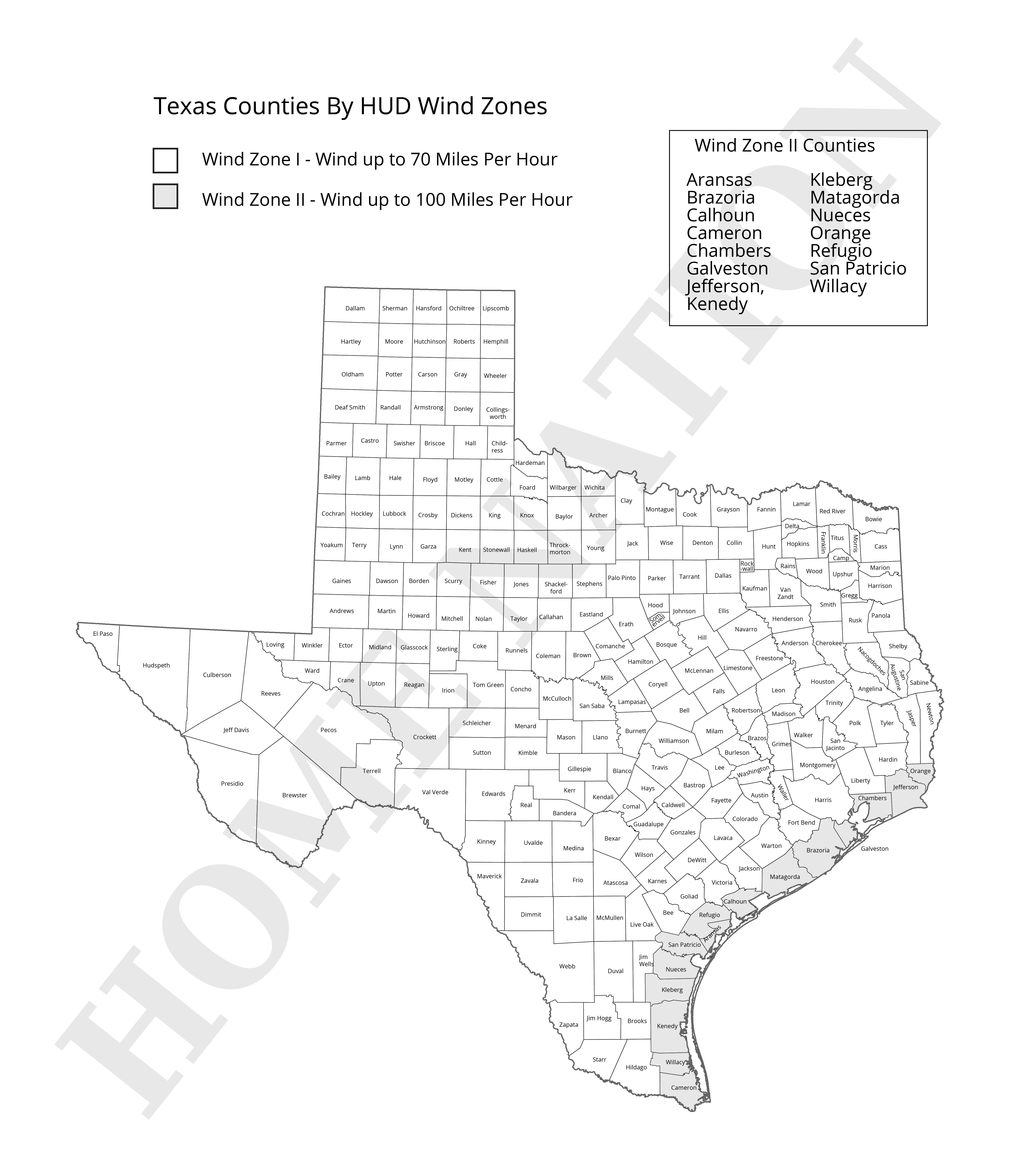
Wind Zone 2: Applies to 15 specific counties along the Gulf Coast. Homes must resist winds up to 100 mph. These coastal areas face higher risks during hurricanes and tropical storms.
Each wind zone has specific engineering requirements. Homes built for higher zones include reinforced framing, stronger roof systems, enhanced anchoring, and upgraded fastening throughout the structure. These aren't cosmetic differences, they're critical safety features built into the home's design.
Related: Top 5 Texas Prefab Home Companies

Texas Wind Zone 2 Counties
According to Texas law, the following counties require Wind Zone 2 certification:
Counties such as Brazoria, Aransas, Cameron, Chambers, Calhoun, Jefferson, Galveston, Kenedy, Kleberg, Matagorda, Nueces, Orange, Refugio, San Patricio, and Willacy are part of Wind Zone 2. Portions of eastern Harris County, particularly near Highway 146, including Seabrook, Shore Acres, Pasadena, La Porte, and Morgan’s Point, also meet the same classification.
If you’re considering property around Brownsville, Port Arthur, Galveston, or Corpus Christi, chances are it’s in a Zone 2 location, check with your local building office to confirm before buying.
Why Wind Zones Matter
This part is essential: a home constructed for Wind Zone 1 can’t be installed in an area classified as Wind Zone 2. Doing so breaks HUD rules and endangers anyone living there. Manufacturers are not allowed to set up homes with lower wind ratings in locations that demand stronger standards.
However, you can do the opposite. A home built to Wind Zone 2 standards can be installed in a Wind Zone 1 location. Some buyers choose this option for added safety or if they plan to relocate in the future.
Understanding different types of mobile homes and their construction standards helps you make informed decisions. Wind zone ratings affect more than just safety. They impact insurance costs, property values, and resale options.
How Wind Zones Affect Your Home
Wind zone classifications directly influence several aspects of your manufactured home:
-
Structural Design: Higher zones require stronger materials and reinforced connections
-
Installation Requirements: Installing and setting up mobile homes in Zone 2 areas involves stricter anchoring systems
-
Insurance Coverage: Companies often require proof of proper wind zone certification
-
Compliance with Standards: Homes must meet updated building codes for their designated zone
The HUD Code ensures that manufactured homes meet federal safety standards. Every home must display a HUD Certification Label confirming it was built to the correct wind zone specifications. This focus on building resilience protects homeowners during extreme weather events.
Related: Cost To Build A House In Texas
Texas Weather Patterns and Storm Risk
The Gulf Coast faces the highest wind risks in Texas. Hurricane season runs from June through November, bringing potential for storm surge, flooding, and sustained high winds. Storms like Hurricane Harvey (2017) and Hurricane Ike (2008) caused devastating damage to coastal communities.
Interior counties still experience strong winds from severe thunderstorms and occasional tornadoes, but these events typically don't produce the sustained wind speeds that hurricanes generate. That's why most inland areas only require Wind Zone 1 certification.
Texas Wind Zone Mobile Homes
Ready to find the right home for your Texas location? Understanding wind zones protects your investment and keeps your family safe. Whether you're in Dallas or Galveston, matching your home to the correct wind zone isn't optional, it's required by law.
Home Nation helps Texas buyers find manufactured homes that meet local wind zone requirements. Every home is built to HUD standards and comes with proper certification for your area. Get pre-approved today at homenation.com/preapproval or explore options to sell your current home and upgrade to a compliant manufactured home.
Don't risk your safety or your investment. Choose a home built specifically for Texas wind conditions.